Valve Testing
Valve Testing & Inspections
Certifications & Quality Assurance
API 598
The API 598 (American Petroleum Institute) is the standard that specifies the inspection and testing requirements for valves. It defines procedures for pressure testing, leakage acceptance criteria, and test methods for various valve types and end connections. API 598 applies to valves used in oil, gas, petrochemical, and related industries, and ensures valve integrity, tight shutoff, and reliable performance before installation and service.
ASME B16.34
The ASME B16.34 (American Society of Mechanical Engineers) is the standard that covers all aspects of valve designs; materials, test pressures; temperature ratings, valve dimensions and the non-destructive examination of all cast, forged and fabricated valves. This covers all flanged, threaded and weld end valves. The ASME B16.34 ensures the safety and reliability of valves in numerous applications.
ASME B31.1
The ASME B31.1 (American Society of Mechanical Engineers) is the standard that governs the design, materials, fabrication, examination, inspection, testing, and operation of power piping systems. It applies primarily to piping associated with electric power generating stations, industrial plants, and central and district heating systems. ASME B31.1 ensures the safe, reliable, and efficient transport of high-pressure and high-temperature fluids by establishing requirements that address mechanical integrity, service conditions, and operational safety.
Dye Penetration Inspection
Dye Penetrant Inspection (DPI) for valves is a non-destructive examination (NDE) method used to detect surface-breaking defects such as cracks, porosity, laps, or seams on non-porous valve components.
Radiography Inspection
Radiography Inspection for Valves is a non-destructive examination (NDE) method used to evaluate the internal integrity of valve castings, welds, and pressure-containing components.
Helium Leak Testing
Helium Leak Testing for valves is a highly sensitive testing method used to verify the leak-tightness and integrity of valve pressure boundaries and sealing components. Helium gas is used as the test medium due to its small molecular size and inert properties, allowing detection of extremely low leakage rates.
Nitrogen Leak Testing
Nitrogen Leak Testing for valves is a method used to verify the tightness and integrity of valve pressure boundaries and sealing surfaces using nitrogen gas as the test medium.
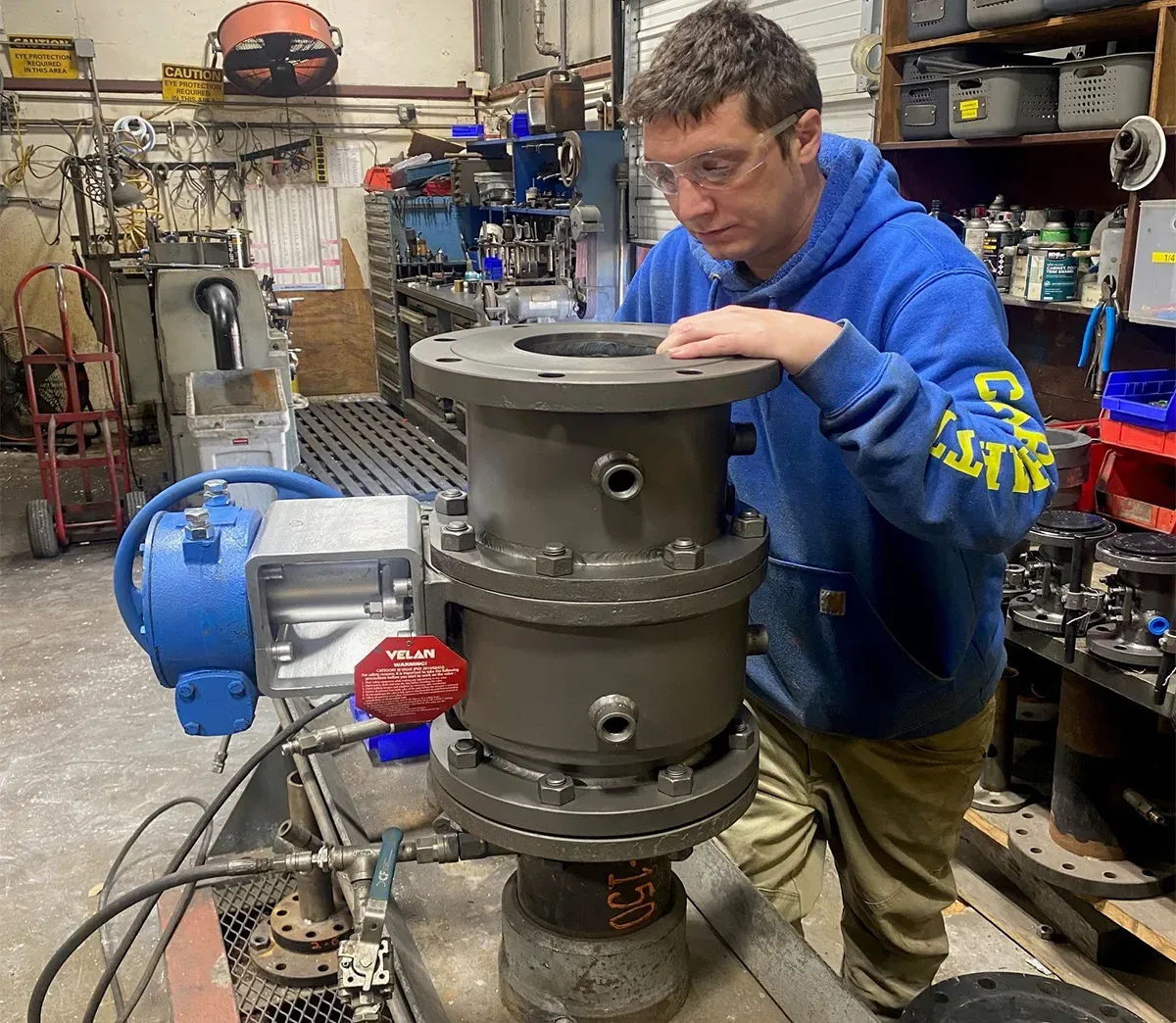
Process End of Fully Jacketed Velan Full Port Ball Valve Being Tested